This page is a historical and cultural note. Baltic Way Ride is an independent motorcycle travel concept and is not an official commemorative project.
A historical line across three countries
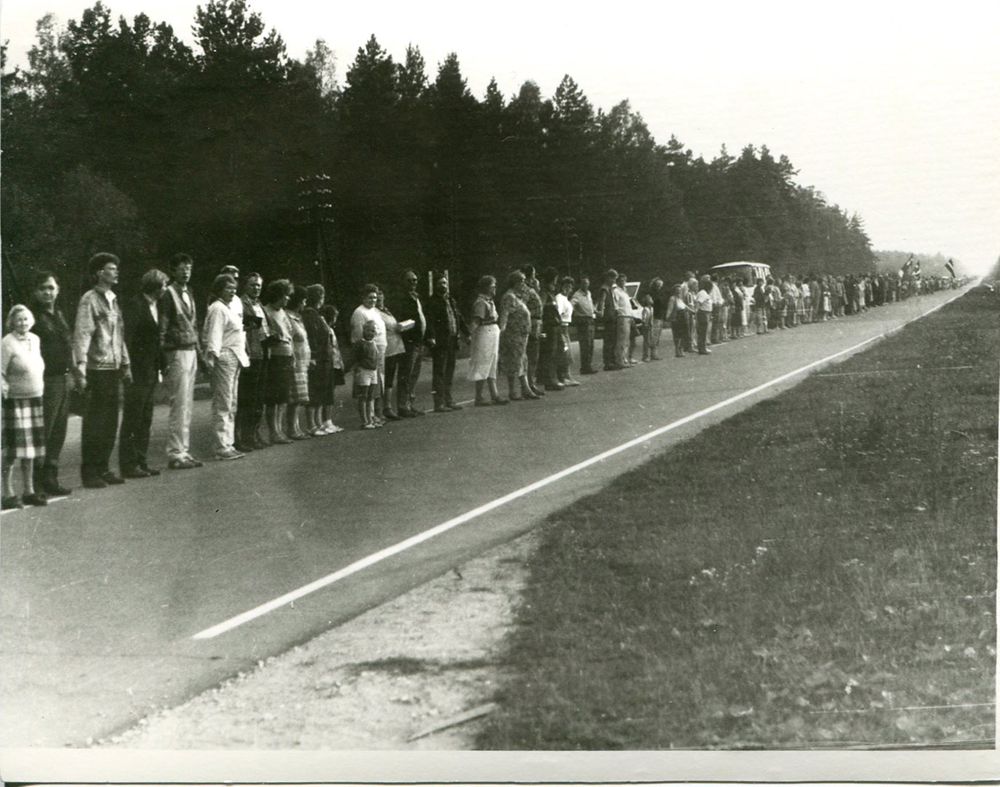
On 23 August 1989, around two million people held hands across Lithuania, Latvia and Estonia. The human chain stretched roughly 600 km, from Vilnius in the south to Tallinn in the north, passing through Riga in the middle. It was the fiftieth anniversary of the Molotov–Ribbentrop pact, the secret agreement that had handed the three countries to the Soviet Union in 1939.
The chain had no leader and no speeches. At a quarter to seven, church bells rang across the three countries. At seven in the evening people joined hands and stood there for about fifteen minutes. Two years later, all three countries were independent.
The route they formed that day still exists. It runs along the same main roads that connect the three Baltic capitals today.
The geography of the line
The Baltic Way was never a single road. It was a corridor, made of whatever roads passed through whatever towns happened to be on the way between Vilnius and Tallinn. People stood where they could — on highways, on country lanes, in village squares. The chain bent and stretched depending on local geography.
What stayed constant was the north–south spine. From Vilnius the line moved through Kaunas — Lithuania’s second city, on the Neman river — and then north towards Panevėžys and Pasvalys, in the country’s quiet northern plains. It crossed into Latvia near Bauska, a small town with a castle and a river, and continued to Riga, the symbolic middle point.
North of Riga the chain entered Vidzeme, the Latvian region that includes Sigulda and Cēsis — towns at the edge of Gauja National Park, where the landscape changes from open plains to forested river valleys. From Valmiera the line approached the Estonian border at Valka and Valga, the twin towns that face each other across the border. It is one of Europe’s most distinctive border crossings: one main square, two flags, two languages.
In Estonia the chain continued through Tartu — the country’s old university city — and then northwest through Paide, almost in the geographical centre of the country, before reaching Tallinn on the Baltic Sea.
Why this line matters on a motorcycle
For a rider, the Baltic Way is not a famous route. It does not appear in lists of European motorcycle classics. It has no mountain passes, no spectacular curves, no postcard panoramas. The roads are mostly straight, the elevation mostly flat, the traffic mostly light.
But it has something rarer: it follows a line drawn by people, not by terrain. Every town along it stood in the chain in 1989. Every village had someone in it that day. Riding through them decades later, the rider passes through a country that decided its future in a single afternoon — and then quietly went back to its life.
The roads themselves are honest. The main corridors — the A1 and A8 in Lithuania, the A7 and A2 in Latvia, the 2 in Estonia — are well maintained and often surprisingly empty north of the capitals. The secondary roads that parallel them are slower, narrower, and run through the small towns that the highways now bypass. Either choice is valid. The chain stood on both.
Fuel is easy. Food is easy. The countryside is open and the skies are huge — the Baltic latitude means that in June the sun barely sets, and a long ride at ten in the evening still feels like late afternoon.
Three sections, three characters
The Lithuanian section feels like the warmest of the three. The towns are bigger and busier, the architecture leans Catholic and Central European, and the food reflects the country’s long history at the crossroads between the Baltic and Eastern European worlds. Riding north out of Vilnius, the country opens slowly into farmland.
The Latvian section is the most varied. Riga in the middle gives the route a real city — broad, of old Hanseatic tradition, with a German old town and a riverfront that has crossed centuries of history. North of Riga the Gauja valley brings forests and small castles. South of Riga the road rolls quietly through fields and birch.
The Estonian section has its own character. The language is Finno-Ugric, closer to Finnish than to its Baltic neighbours, the towns are quieter, the design has a Nordic sensibility. The road from Tartu to Tallinn passes through Paide and a sequence of small Estonian villages, with very little between them. By the time the Baltic Sea appears on the horizon, the south of the route feels far away.
A note from someone who has ridden it
I have ridden parts of this route many times, in different seasons. The honest report is that it is not a route of dramatic moments. It is a route of long days, even light, small towns that empty out at nine in the evening, and one quiet realisation per day that something specific happened on this exact stretch of road in 1989.
That is its nature. Anyone who comes here looking for the next Stelvio or the next Transfăgărășan will be disappointed. Anyone who comes to ride a line drawn by two million people, slowly and on small roads, will find more than they expected.
Fuel use and emissions on a 450cc Euro 5 motorcycle
For a concrete reference: a mid-size Euro 5 motorcycle (around 450cc) uses on average about 4 litres of petrol per 100 km at Baltic cruising speed — flowing roads, light traffic, 90 to 100 km/h.
Over the full Vilnius–Tallinn route, around 650 km of actual riding:
- Total fuel: about 26 litres of petrol
- CO₂ emissions: about 60 kg (based on 2.31 kg of CO₂ per litre of petrol, standard European conversion factor)
- Per kilometre: about 92 g CO₂/km
A Euro 5 motorcycle is regulated under EU Regulation 168/2013 and meets strict limits on carbon monoxide (1,000 mg/km), total hydrocarbons (100 mg/km), nitrogen oxides (60 mg/km) and particulate matter (4.5 mg/km). These limits are equivalent to those applied to Euro 6 passenger cars. A Euro 5 motorcycle can ride without restrictions across Lithuania, Latvia and Estonia. There are no environmental low-emission zones along the route.
Sources
Historical information on the Baltic Way is drawn from public records, including the UNESCO Memory of the World Register, where the Baltic Way documentation has been inscribed since 2009.
- UNESCO Memory of the World Programme — The Baltic Way: Human Chain Linking Three States in Their Drive for Freedom: unesco.org
- Latvian National Commission for UNESCO — The Baltic Way archive: thebalticway.eu
- Estonian Public Broadcasting (ERR) — The Baltic Way: 35 years since 2 million protest for freedom from Soviets: news.err.ee
- European Parliament resolution of 2 April 2009 establishing 23 August as the European Day of Remembrance for Victims of Stalinism and Nazism.
Technical figures on motorcycle fuel consumption and emissions are based on European regulatory standards and recognised conversion factors.
- European Union — Regulation (EU) No 168/2013 on the approval and market surveillance of two- or three-wheel vehicles and quadricycles: eur-lex.europa.eu
- ACEM — European Association of Motorcycle Manufacturers, press release on the Euro 5 environmental standard (December 2019): acem.eu
- CO₂ conversion factor for petrol (2.31 kg CO₂ per litre) consistent with the UK Department for Energy Security and Net Zero (DESNZ) conversion factors and the European Environment Agency methodology.
- Real-world fuel consumption figures for mid-size Euro 5 motorcycles (Honda CB500X, KTM 390 Adventure, Royal Enfield Himalayan 450) based on manufacturer specifications and independent road tests.
This page is intended as a respectful historical introduction to the Baltic Way and its meaning. Baltic Way Ride is an independent motorcycle travel concept inspired by the route and memory of the Baltic Way. It is not an official commemorative project and is not affiliated with any government institution, museum or political organisation.
Last updated: April 2026.
🇮🇹 Italiano
Una linea storica attraverso tre paesi
Il 23 agosto 1989, circa due milioni di persone si tennero per mano attraverso Lituania, Lettonia ed Estonia. La catena umana si estendeva per circa 600 km, da Vilnius a sud fino a Tallinn a nord, passando per Riga al centro. Era il cinquantesimo anniversario del patto Molotov–Ribbentrop, l’accordo segreto che nel 1939 aveva consegnato i tre paesi all’Unione Sovietica.
La catena non aveva un capo né discorsi. Alle sei e quarantacinque suonarono le campane delle chiese nei tre paesi. Alle sette di sera la gente si prese per mano e rimase così per circa quindici minuti. Due anni dopo, tutti e tre i paesi erano indipendenti.
Il percorso che formarono quel giorno esiste ancora. Segue le stesse strade principali che oggi collegano le tre capitali baltiche.
La geografia della linea
La Baltic Way non è mai stata una strada sola. Era un corridoio, fatto di qualunque strada attraversasse qualunque paese si trovasse sul cammino tra Vilnius e Tallinn. La gente si mise dove poteva — sulle statali, sulle strade di campagna, nelle piazze dei villaggi. La catena si piegava e si allungava a seconda del territorio.
Quello che restava costante era la spina dorsale nord–sud. Da Vilnius la linea passava per Kaunas — la seconda città lituana, sul fiume Nemunas — e poi saliva verso Panevėžys e Pasvalys, nelle pianure tranquille del nord del paese. Entrava in Lettonia vicino a Bauska, una cittadina con un castello e un fiume, e proseguiva fino a Riga, il punto centrale e simbolico.
A nord di Riga la catena entrava in Vidzeme, la regione lettone che comprende Sigulda e Cēsis — due cittadine ai margini del Parco Nazionale della Gauja, dove il paesaggio cambia: dalle pianure aperte alle valli boscose. Da Valmiera la linea si avvicinava al confine estone a Valka e Valga, le due città gemelle che si fronteggiano sul confine. È uno dei passaggi di confine più particolari d’Europa: una sola piazza, due bandiere, due lingue.
In Estonia la catena proseguiva attraverso Tartu — la vecchia città universitaria del paese — e poi a nord-ovest passando per Paide, quasi al centro geografico del paese, prima di raggiungere Tallinn sul Mar Baltico.
Perché questa linea conta su una moto
Per un motociclista, la Baltic Way non è un percorso famoso. Non compare nelle liste dei classici motociclistici europei. Non ha passi di montagna, né curve spettacolari, né panorami da cartolina. Le strade sono per lo più dritte, l’altitudine quasi piatta, il traffico leggero.
Ma ha qualcosa di più raro: segue una linea tracciata da persone, non dal terreno. Ogni paese lungo il percorso fece parte della catena nel 1989. In ogni villaggio quel giorno c’era qualcuno. Decenni dopo, attraversandoli in moto, si passa per un paese che decise il proprio futuro in un solo pomeriggio — e poi, in silenzio, tornò alla sua vita.
Le strade sono oneste. I corridoi principali — A1 e A8 in Lituania, A7 e A2 in Lettonia, la 2 in Estonia — sono ben tenuti e spesso sorprendentemente vuoti a nord delle capitali. Le strade secondarie che corrono parallele sono più lente, più strette, e attraversano i piccoli paesi che le statali oggi evitano. Entrambe le scelte sono valide. La catena passava su tutte e due.
Il carburante si trova facilmente. Anche il cibo. La campagna è aperta e i cieli enormi — la latitudine baltica fa sì che a giugno il sole quasi non tramonti, e una lunga cavalcata alle dieci di sera sembra ancora tardo pomeriggio.
Tre tratti, tre caratteri
Il tratto lituano è il più caldo dei tre. Le città sono più grandi e vivaci, l’architettura tende al cattolico e centro-europeo, e la cucina riflette la lunga storia del paese al crocevia tra mondo baltico ed europeo orientale. Salendo da Vilnius verso nord, il paese si apre lentamente nella campagna.
Il tratto lettone è il più vario. Riga, al centro, dà al percorso una città vera — ampia, di antica tradizione anseatica, con un centro storico tedesco e un lungofiume che ha attraversato secoli di storia. A nord di Riga la valle della Gauja porta foreste e piccoli castelli. A sud di Riga la strada scorre tranquilla tra campi e betulle.
Il tratto estone ha un carattere proprio. La lingua è ugro-finnica, vicina al finlandese più che alle lingue dei vicini baltici, le città sono più silenziose, il design ha un’estetica nordica. La strada da Tartu a Tallinn passa per Paide e una sequenza di piccoli villaggi estoni, con ben poco in mezzo. Quando il Mar Baltico appare all’orizzonte, il sud del percorso sembra lontanissimo.
Una nota da chi l’ha percorsa
Ho percorso parti di questa strada molte volte, in stagioni diverse. Il resoconto onesto è che non è un percorso di momenti drammatici. È un percorso di giornate lunghe, luce uniforme, piccoli paesi che si svuotano alle nove di sera, e una piccola consapevolezza al giorno: che proprio qui, su questo esatto tratto di strada, nel 1989 successe qualcosa di preciso.
È la sua natura. Chi viene cercando il prossimo Stelvio o la prossima Transfăgărășan resterà deluso. Chi viene per percorrere una linea tracciata da due milioni di persone, con calma e su strade piccole, troverà più di quanto si aspettava.
Consumi ed emissioni su una moto 450 Euro 5
Per un riferimento concreto: una moto di media cilindrata Euro 5 (intorno ai 450 cm³) consuma in media circa 4 litri di benzina ogni 100 km a velocità di crociera baltica — strade scorrevoli, poco traffico, andatura tra i 90 e i 100 km/h.
Sul percorso completo Vilnius–Tallinn, circa 650 km di guida effettiva:
- Consumo totale: circa 26 litri di benzina
- Emissioni di CO₂: circa 60 kg (calcolate su 2,31 kg di CO₂ per litro di benzina, fattore di conversione standard europeo)
- Equivalente per chilometro: circa 92 g di CO₂/km
Una moto Euro 5 è regolamentata dal Regolamento UE 168/2013 e rispetta limiti rigorosi di emissioni: monossido di carbonio (1.000 mg/km), idrocarburi totali (100 mg/km), ossidi di azoto (60 mg/km) e particolato (4,5 mg/km). Questi limiti sono equivalenti a quelli applicati alle auto Euro 6. Una moto Euro 5 può circolare senza restrizioni in Lituania, Lettonia ed Estonia. Lungo il percorso non esistono zone a traffico limitato di carattere ambientale.
Fonti
Le informazioni storiche sulla Baltic Way provengono da fonti pubbliche, incluso il Registro UNESCO Memory of the World, dove la documentazione della Baltic Way è iscritta dal 2009.
- UNESCO Memory of the World Programme — The Baltic Way: Human Chain Linking Three States in Their Drive for Freedom: unesco.org
- Commissione Nazionale Lettone per l’UNESCO — archivio The Baltic Way: thebalticway.eu
- ERR — Radiotelevisione pubblica estone, The Baltic Way: 35 years since 2 million protest for freedom from Soviets: news.err.ee
- Risoluzione del Parlamento Europeo del 2 aprile 2009 che istituisce il 23 agosto come Giornata Europea della Memoria per le vittime dei regimi totalitari.
I dati tecnici su consumi ed emissioni delle motociclette si basano su standard normativi europei e fattori di conversione riconosciuti.
- Unione Europea — Regolamento (UE) n. 168/2013 sull’omologazione e la vigilanza del mercato dei veicoli a motore a due o tre ruote e dei quadricicli: eur-lex.europa.eu
- ACEM — Associazione Europea dei Costruttori di Motocicli, comunicato stampa sullo standard ambientale Euro 5 (dicembre 2019): acem.eu
- Fattore di conversione CO₂ per la benzina (2,31 kg di CO₂ per litro), coerente con i fattori di conversione del Department for Energy Security and Net Zero (DESNZ) del Regno Unito e con la metodologia dell’Agenzia Europea dell’Ambiente.
- Dati di consumo reali per motociclette di media cilindrata Euro 5 (Honda CB500X, KTM 390 Adventure, Royal Enfield Himalayan 450) basati su specifiche di fabbrica e prove indipendenti su strada.